Posts

Pure Pajamas, by Marc Bell

Image
Picked this one up, a Drawn n' Quarterly hard cover compilation released in 2011 by Marc Bell.  I have to say I really enjoyed it.  It's one of those light hearted explorations of the subconscious, while marginally censored, that I enjoy.  Often comics are rampant with brutality and sex because of the male-centric demographic of repressed, wimpy readers.  Be it Iron Man or the wild eyed glam psychos of Suehiro Maruo, or R. Crumb's fidgeting libidinous penmanship of thick Jewish ham-hocks. Speaking of which, Marc is clearly influenced by R. Crumb.  The bluesy ragtime era dialogues that harken back to the days of Krazy Kat and Bugs Bunny set the tone for his work, and the numerous little characters and bizarre landscapes lend themselves to LSD inspired dreamscapes.  But in Marc Bell's world some one has picked up all the garbage and policed the area for sleaze.  It seems a bit more like the inside of the S.F. Moma rather than 60's era Haight Street. ...
Image
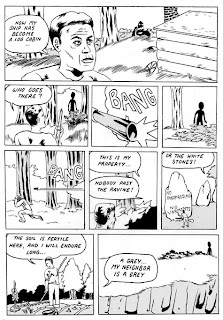
Blam by Roy Lichtenstein was originally All American Men of War #89 by Russ Heath.  And here I present to you "Bang" by Aaron Kaneshiro.  The memetic transmission of ideas from one artist to another lead to infinite redundancy and connectivity.  Here I tried to draw a parallel between the world of Davey Crockett and Science Fiction.  Boys with their guns in the wild, facing down adversities with violence and square jaws. Here I am trying to incorporate the EC/DC comics style of the 50's more.  The one principle I stumbled on today was the fact that line widths express lighting and give objects volume through subtle variation.  In Japanese work it is more common to see a uniform line that encompasses every object with the same width, and depth is created more through observed shapes.  Using a brush more than not seems to help.  There's a great sense of dynamics they communicated with in that era in the line widths and accents.  I hope to obta...
Image

Aaron Shunga's Recent reads

Image
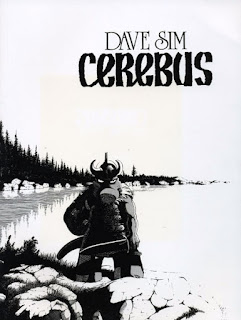
Cerebus:  Form and Void- David Sim This book is an ambitious meld between fantasy and a critique of Ernest Hemingway.  Aside from being entirely cerebral, it is accompanied by very powerfully drawn winter scenes in a beautiful, photorealistic style.  Many objects are depicted as suspended fragments of shadow.  There is a long flashback featuring Ernest Hemingway's wife taking us through a recollection of her safari in Africa.  The story is overall effective in making us feel the sense of desperation during a blizzard and the anguish of such a long, arduous trail. My gripes are with the pacing and the composition.  A good deal of the scenes could stand to be illustrated in a more conventional style, as varying panel sizes tend to needlessly divert attention from the story.  A lot of dialogue had a tendency to change font and even include objects in the sound effects that represent letters (scissors as the letter P.)  I found these variations t...